
Extraction Fundamentals
Time, Temperature, and the Shape of a Good Cup
Time and temperature are the two forces that govern how a cup unfolds. Hotter water pulls flavor more aggressively. Longer contact allows more of that flavor to arrive. These two forces work together, and learning how they interact is the heart of brewing.
Shorter methods like espresso use very hot water at high pressure for a brief window, perhaps twenty-five to thirty seconds. Longer methods like French press let slightly cooler water sit with the coffee for four minutes or more. Cold brew sets aside heat entirely and lets twelve to sixteen hours of contact do what temperature would otherwise accomplish. Each method arranges time and temperature differently, and each produces a cup with its own character.
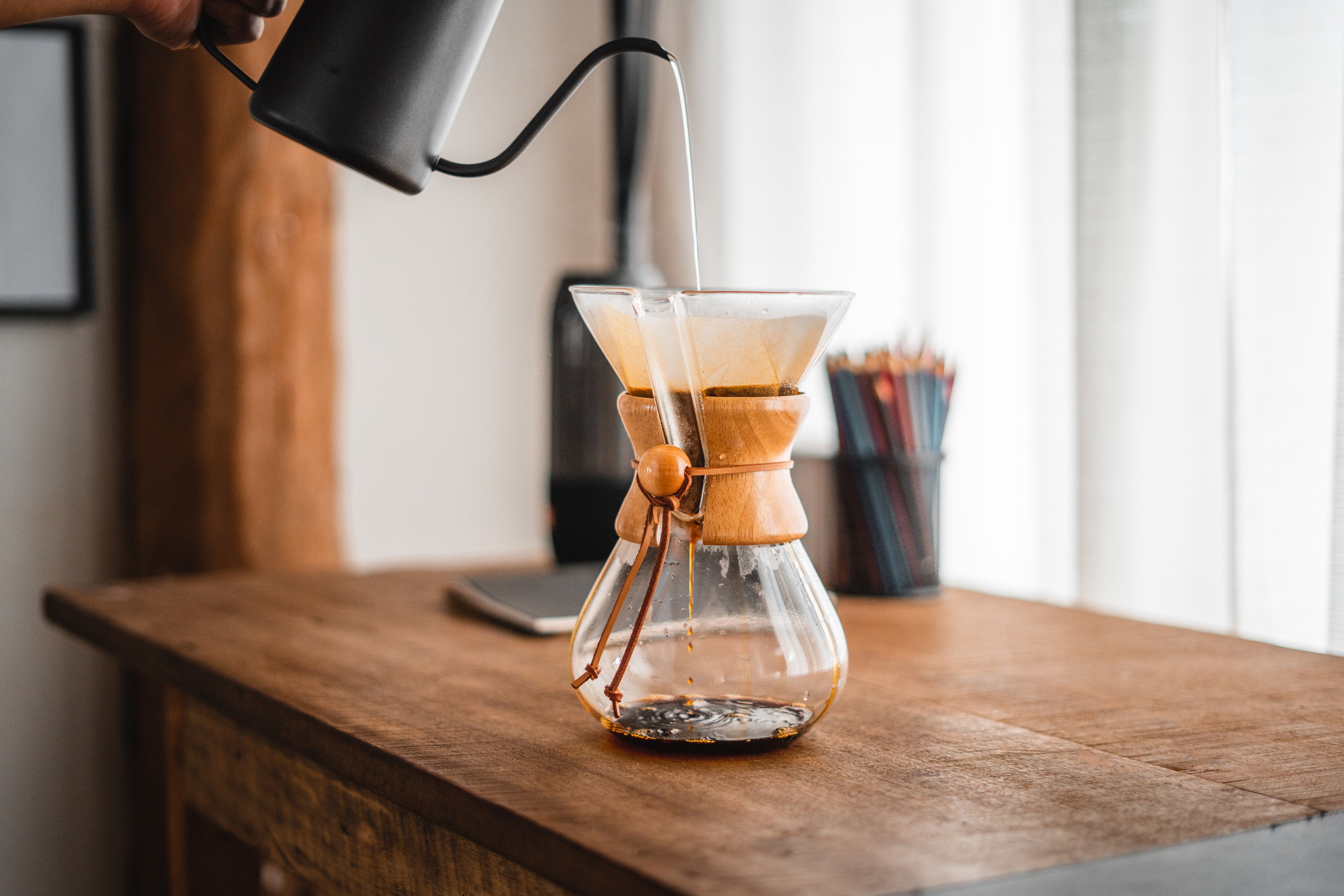
What's worth knowing is that time and temperature can substitute for each other in surprisingly mathematical ways. Coffee chemistry research has established that extraction roughly doubles in rate for every 10 degrees Celsius (18 degrees Fahrenheit) increase in water temperature, a relationship known in chemistry as the Q10 coefficient. This means that water at 95°C (203°F) extracts approximately twice as fast as water at 85°C (185°F). A pour-over brewed at 95°C (203°F) in 3 minutes produces similar extraction levels to the same coffee brewed at 85°C (185°F) in roughly 6 minutes. This is why cold brew works at all — the room-temperature water extracts at perhaps a tenth of the rate of hot water, but 12 to 16 hours of contact produces enough total extraction to fill the cup. The same principle explains why a pour-over brewed at 90°C (194°F) rather than 96°C (205°F) requires a longer brew time to land in the same place, and why espresso's brief window only works because the temperature is high enough to compress hours of cold extraction into 25 seconds.
This relationship gives brewers a hidden lever. When a coffee tastes too bright at standard temperature, lowering temperature by 4 to 5 degrees Celsius (7 to 9 degrees Fahrenheit) and extending time by 20 to 30 percent often produces a sweeter, rounder cup with the same total extraction but a different compound profile arriving at different times. Lower temperatures preferentially extract sugars and brighter compounds while suppressing bitter phenolics, which is why the cooler-and-longer approach often produces what tasters call "tea-like clarity." Higher temperatures with shorter times pull more aromatic compounds and produce more dimensional cups but require precision because the window between balanced and over-extracted narrows considerably.
A cup that lands in balance is one where time and temperature have been matched well to the grind, the coffee, and the vessel. When the cup drifts toward one end of the range or the other, these two variables are almost always where the adjustment lives. Café de Volcán thinks of every brewing method as a particular proportion of heat and duration, and every cup as the outcome of how they were balanced on that morning.