
Grind & Equipment
The Role of Temperature in Your Brewing Water
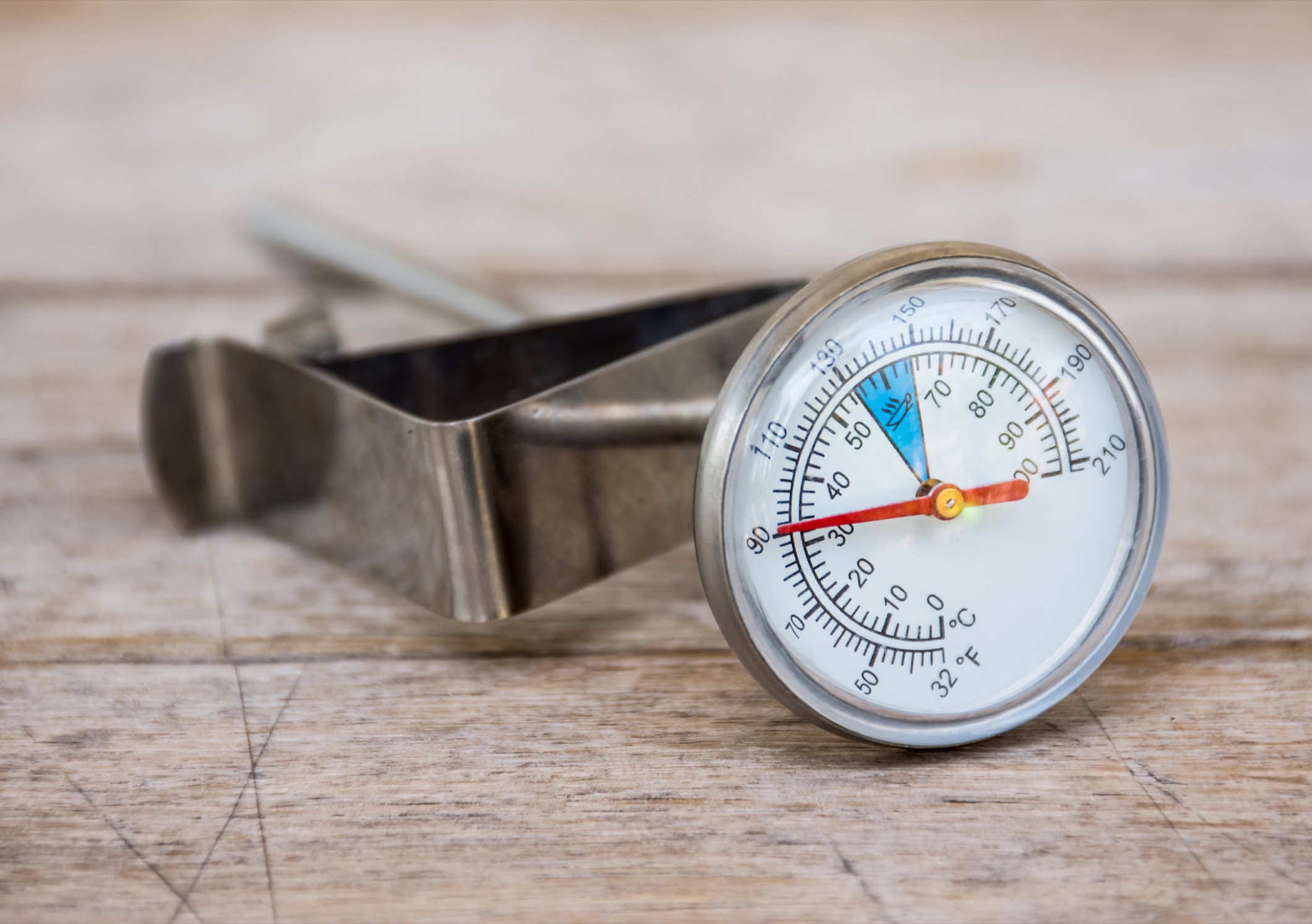
Water temperature controls how aggressively flavor moves from the coffee into the brew. Hotter water extracts faster and more fully, while cooler water extracts more gently and selectively. The specialty range for most brewing methods sits between roughly 90 to 96°C (195 to 205°F) — water hot enough to extract well, but not so hot that it scalds the coffee.
The chemistry behind temperature's influence on extraction rests on a principle from physical chemistry called the Arrhenius equation, which describes how reaction rates change with temperature. For coffee extraction specifically, the practical rule is that extraction rate roughly doubles for every 10 degrees Celsius (18 degrees Fahrenheit) increase in water temperature — a relationship known as the Q10 coefficient. Water at 95°C (203°F) extracts approximately twice as fast as water at 85°C (185°F). Water at 75°C (167°F) extracts roughly four times slower than water at 95°C (203°F). This is why cold brew works at all — room-temperature water extracts at perhaps a tenth of the rate of hot water, but 12 to 16 hours of contact compensates for the slower kinetics by giving compounds enough time to dissolve.
Different compounds in coffee respond to temperature differently, which is why temperature changes don't just speed or slow extraction uniformly — they shift which compounds extract most readily. Acids like citric, malic, and chlorogenic acid extract efficiently even at lower temperatures, which is part of why cold brew tastes notably sweet and low in acidity (the acids extract relative to other compounds). Sugars and Maillard reaction products require somewhat warmer temperatures and extended contact to fully release. The bitter chlorogenic acid lactones and larger phenolic compounds require both heat and time, which is why over-hot brewing produces disproportionate bitterness — the temperature accelerates extraction of bitter compounds more than proportionally compared to balancing compounds.
There's also a physical effect at the molecular level. Hot water molecules move faster and have more kinetic energy, which lets them penetrate coffee particles more aggressively and dissolve compounds more efficiently. Hot water also reduces water's surface tension, which means it wets coffee grounds more thoroughly and reaches into pores in the particle structure that cooler water leaves dry. The combination of faster molecular motion, lower surface tension, and increased solubility for many compounds produces extraction efficiency that scales nonlinearly with temperature within the brewing range.
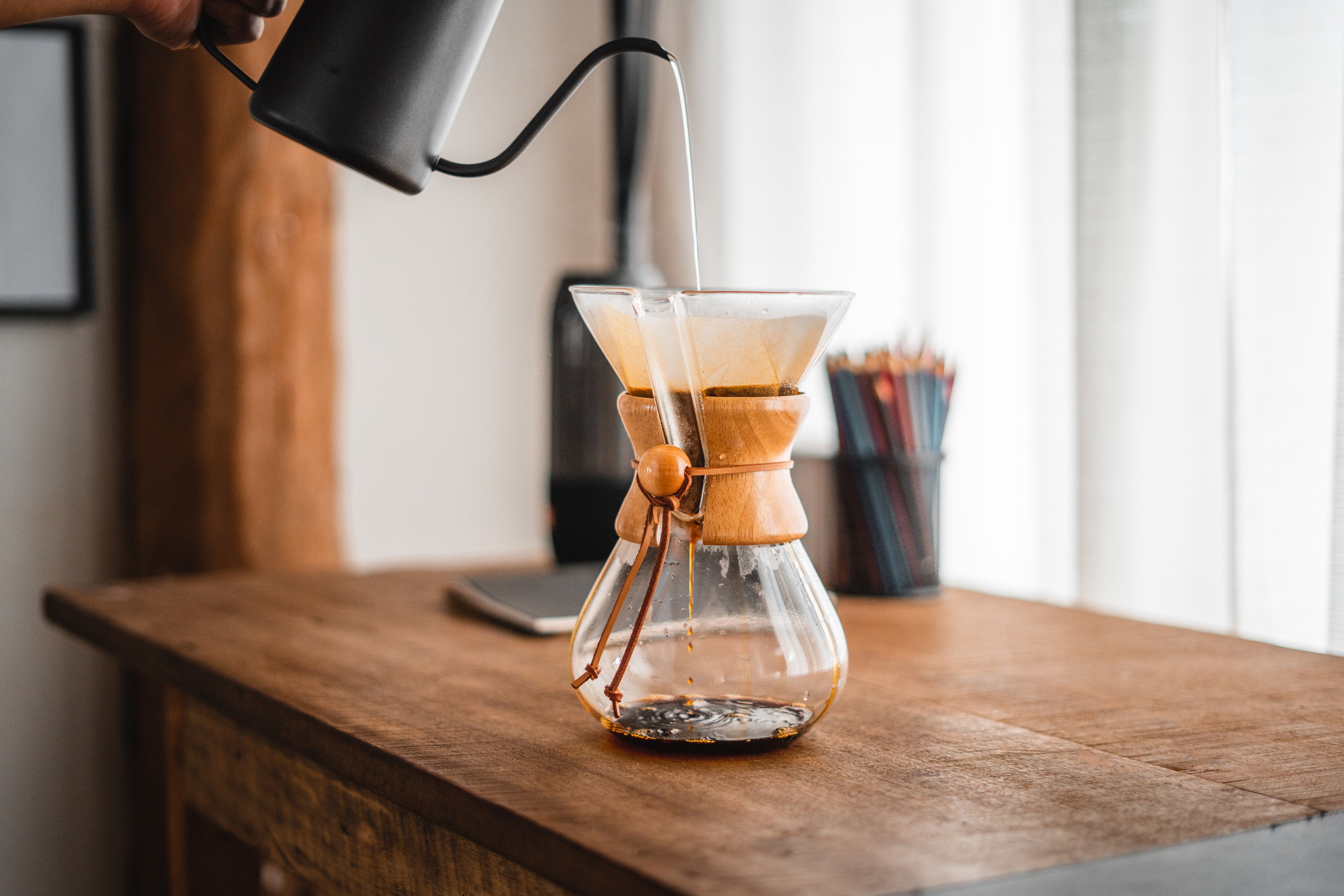
Different methods favor slightly different points within that range. Pour-over often performs best at the higher end, where extraction is fully active and the brew flows cleanly through the bed. French press tolerates slightly lower temperatures because the longer contact time compensates for the slower extraction kinetics. Espresso typically holds steady near 93°C (200°F), where pressure and heat combine most expressively to produce the rapid extraction that defines the method.
Outside the range, the cup shifts noticeably. Water too hot extracts the bitter phenolic compounds and chlorogenic acid lactones aggressively, introducing harshness and astringency that no other adjustment fully resolves. Water too cool leaves the cup thin or sour because the sugars and balancing compounds haven't fully released — the acids extracted efficiently while the sweetness remained locked in the particle interior. The temperature range exists because it produces the balance where extraction is fast enough to release the full compound profile but not so fast that bitter compounds dominate.
Café de Volcán views brewing temperature as one of the most rewarding variables to dial in precisely, because small shifts produce clear differences in what the cup offers. A 2°C (3.6°F) change in brewing temperature produces measurable cup changes that experienced brewers can taste reliably.