
Panama City
The Amador Causeway: Where Panama City Meets the Canal
The Amador Causeway is a 6-kilometer roadway extending from Panama City into the Pacific Ocean, connecting the mainland to four small islands at the entrance of the Panama Canal. The causeway functions as both an engineering feature of the canal infrastructure and one of Panama City's most popular recreational destinations, offering some of the most distinctive views available anywhere in the country — modern city skyline on one side, the Pacific entrance of the canal on the other, with ships waiting their turn to transit the locks visible just offshore.
The causeway's origins trace to the construction of the Panama Canal in the early twentieth century. American engineers needed to address a specific challenge at the Pacific entrance of the canal: strong tidal currents and sediment movement that threatened to silt the channel and complicate ship navigation. The solution was to build a breakwater extending from the mainland out toward the four small islands sitting in Panama Bay, using the breakwater to redirect currents and protect the canal entrance from sedimentation. Material excavated during canal construction — rock, soil, and debris removed during the digging of the canal channel itself — was used to build the breakwater.
The four islands connected by the causeway each developed distinct character over time. Isla Naos, closest to the mainland, hosts the Punta Culebra Nature Center operated by the Smithsonian Tropical Research Institute. The center features small marine exhibits, tide pools accessible at low tide, and educational programming about Panama's marine ecology. Isla Perico, the second island, has developed primarily for restaurants, shops, and commercial space serving the substantial foot and vehicle traffic that the causeway attracts. Isla Flamenco, the third and largest of the developed islands, contains the Flamenco Marina, hotels, restaurants, and the cruise ship terminal. Isla Culebra, the smallest and least developed, remains largely natural.
The Amador Causeway has become one of Panama City's most popular outdoor recreation destinations. The 6-kilometer length, flat terrain, and dramatic views combine to attract walkers, joggers, cyclists, and roller skaters throughout the day. Bicycle rental facilities at the causeway entrance serve casual visitors who want to ride the full length. Weekend evenings draw substantial foot traffic from local residents and visitors enjoying the cooler temperatures after Panama's hot afternoons.
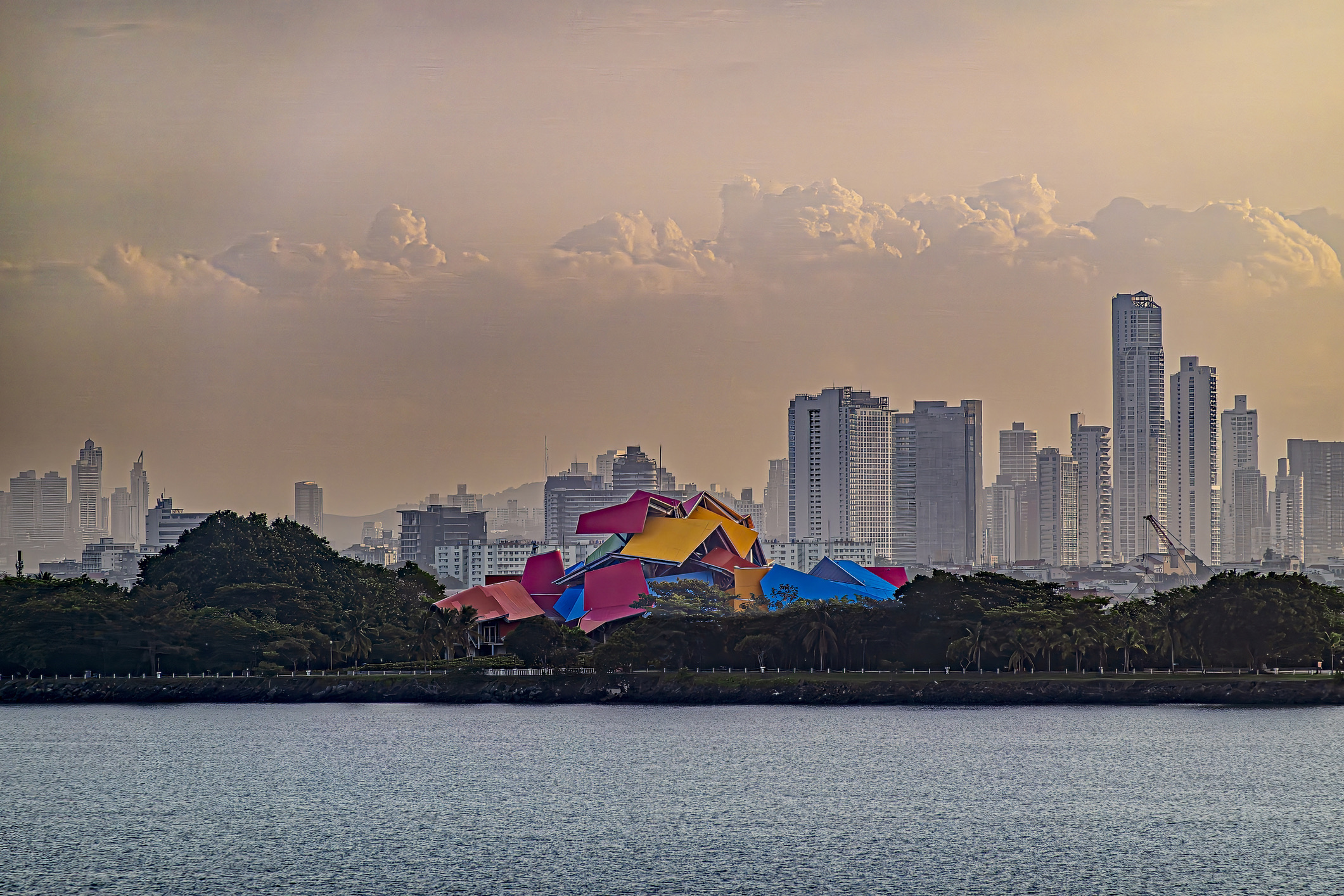
The views from the causeway are genuinely distinctive. Looking back toward the mainland, the modern Panama City skyline rises dramatically — high-rise residential and commercial towers concentrated along the Pacific coast producing a cityscape comparable to major Asian financial centers. Looking out toward the canal, the Bridge of the Americas spans the canal entrance, with its arching steel structure framing ships waiting to enter the lock systems. At night, the city lights, the navigation lights of waiting ships, and the architectural lighting of the Bridge of the Americas combine into one of Latin America's most photographed nighttime urban landscapes.
The Biomuseo sits at the entrance of the causeway on the mainland side, and the building itself has become a Panama City landmark. Designed by Frank Gehry — his only building in Latin America — the Biomuseo opened in 2014 after years of planning and construction. The museum's brightly colored angular roof is visible from across Panama Bay and from the causeway itself, providing a distinctive architectural marker that signals the causeway's beginning. Inside, the museum explores Panama's role in shaping the biodiversity of the Americas through the geological formation of the Isthmus of Panama roughly 3 million years ago. The museum is genuinely substantive rather than just architecturally interesting, and it makes a natural complement to walking the causeway itself.
The causeway also serves several practical purposes related to the canal and to Panama City's commercial life. The cruise ship terminal on Isla Flamenco handles the substantial cruise traffic that passes through the Panama Canal during peak cruise seasons. The marinas on Isla Flamenco and Isla Perico serve recreational vessels and commercial operations including sport fishing charters that work the Pacific waters around Panama. The Smithsonian research facilities on Isla Naos support ongoing scientific work on tropical marine ecology, climate change impacts on coastal environments, and biodiversity research that continues the institute's long history of Panama-based scientific investigation.