
Troubleshooting
Espresso Puck Preparation Part 2: Screens, Pre-Infusion, and Diagnosing
A well-prepared espresso puck — properly dosed, distributed, and tamped as covered in Part 1 — is the foundation. Several additional steps refine the extraction further and several diagnostic patterns help identify what went wrong when shots don't behave as expected.
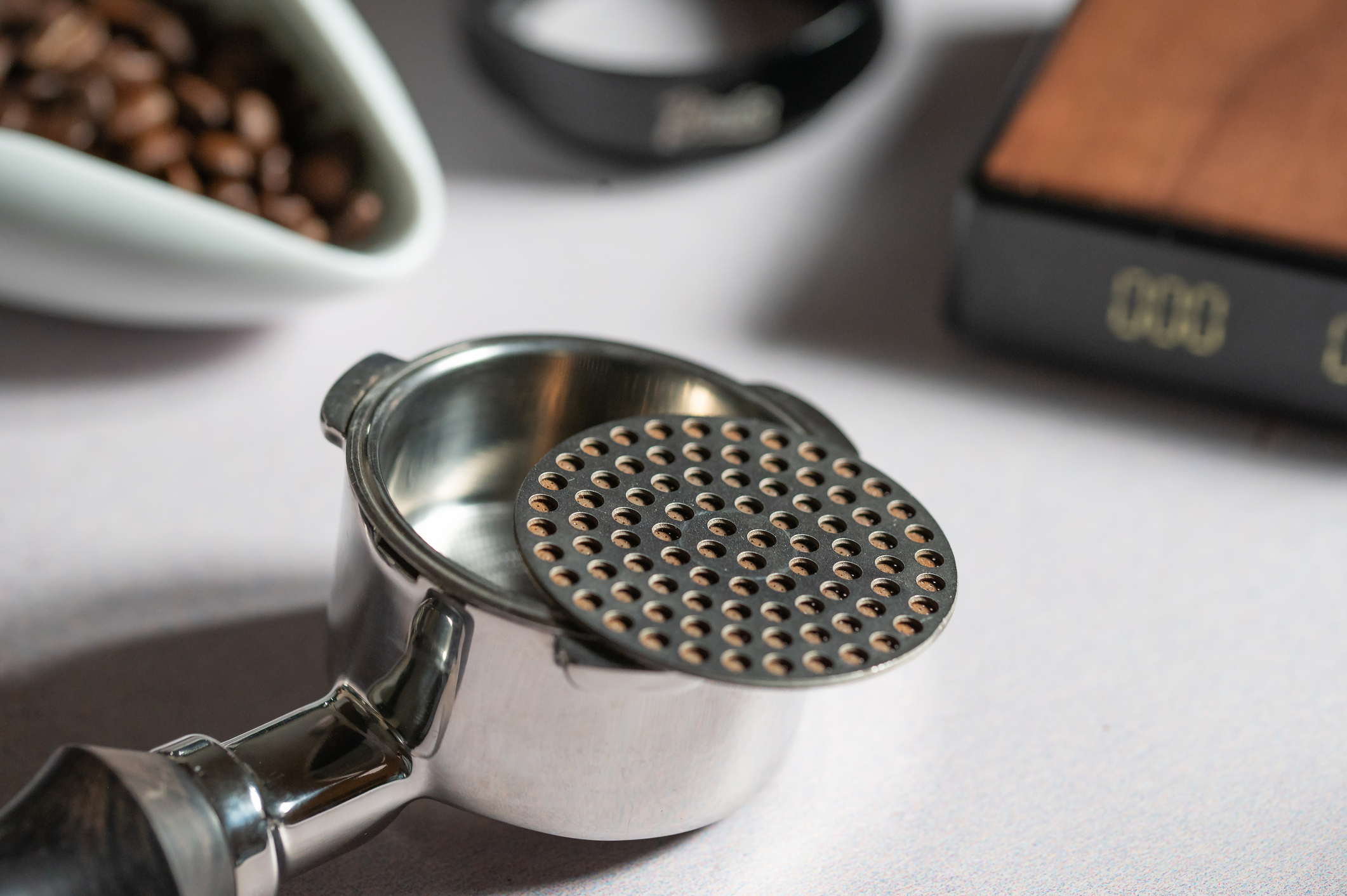
After tamping, some baristas add a puck screen — a thin circular metal mesh disc that sits directly on top of the tamped puck. Puck screens are typically stainless steel with mesh sizes ranging from 100 to 200 microns. The screen acts as a secondary water diffuser between the espresso machine's group head shower screen and the puck surface. When water first hits the puck during extraction, the screen distributes it across the entire surface uniformly rather than allowing the group head's flow patterns to disturb the puck unevenly.
Puck screens add a slight thermal mass that can drop brewing temperature by 1 to 2 degrees Celsius, which experienced users compensate for by raising machine temperature slightly. They also keep the group head's shower screen cleaner because they catch coffee oils and fines that would otherwise migrate up into the machine. Common brands include Normcore, IMS, Aram, Wafo, and Pesado. Most users find the evenness benefit outweighs the temperature drop, particularly with lighter roasts that are more sensitive to channeling.
Once the portafilter is locked into the group head, pre-infusion offers further refinement at the moment extraction begins. Pre-infusion is the technique of running water through the puck at low pressure for a short time — typically 3 to 8 seconds — before the machine engages full pressure. The low-pressure phase saturates the puck uniformly and lets the grounds expand evenly before the high-pressure extraction begins. Without pre-infusion, water at 9 bar hits a dry puck and creates immediate stress, often producing channeling at the moment full pressure engages.
Espresso machines vary in how they handle pre-infusion. Some have programmable pre-infusion built in. Others require manual control through paddle group heads or volumetric programming. Lever machines naturally produce pre-infusion through the way the lever engages. Pressure profiling machines like the Decent or La Marzocco GS3 give users granular control over how pressure ramps up across the shot. Even basic machines can simulate pre-infusion through brief flushes before locking the portafilter.
The full sequence of puck preparation and pre-extraction now works in this complete order: dose into the basket through a funnel, remove the funnel, distribute with WDT to break up clumps, level with a distribution tool if used, tamp with consistent level pressure, place the puck screen on top, lock the portafilter into the group head, and engage pre-infusion before full extraction. Each step compounds the evenness produced by the previous steps.
Several common diagnostic patterns help identify when something has gone wrong:
Channeling around the basket edge usually indicates either an undersized tamper leaving gaps, or a tilted tamp that left one side of the puck thinner. The fix is matching the tamper to the basket precisely (typically a 58.4mm tamper for a 58mm basket) and using a level indicator or self-leveling tamper to ensure verticality.
Channeling in the center usually indicates uneven distribution that left a low-density spot in the middle of the puck. The fix is more thorough WDT, particularly attention to the center of the basket where clumping often concentrates.
Inconsistent shot times across pulls with identical settings usually indicates inconsistent tamping pressure rather than equipment issues. The fix is developing a reliable tamping rhythm or switching to a self-leveling calibrated tamper that eliminates pressure variation.
Sour shots that grinding finer doesn't fix sometimes indicate channeling that's allowing water to escape extraction rather than insufficient extraction overall. Better puck preparation often resolves what grind adjustment cannot. If sourness persists after grinding fine and brewing longer, the issue is probably distribution or tamping rather than extraction.
Bitter shots with normal extraction time sometimes indicate over-extraction in some areas of the puck combined with under-extraction in others — channeling producing the worst of both extremes. The fix is improving puck evenness rather than further extraction adjustments.
Spraying or jetting visible during extraction is a real-time channeling signal. The shot can sometimes be saved by reducing flow rate if the machine allows it, but the underlying preparation needs improvement for subsequent shots.
The discipline of puck preparation, screening, and pre-infusion is the dimension of espresso that distinguishes consistent shots from variable ones. Equipment matters enormously, but a moderately priced espresso machine with disciplined preparation often produces better shots than an expensive machine with sloppy preparation. The skill is genuinely learnable through practice and attention. Café de Volcán treats this complete sequence as the craft of espresso — the work that determines what the machine, the coffee, and the moment can produce together.